
For more than two decades, search advertising operated on a remarkably stable foundation.
Users typed keywords. Advertisers bid for placement. Sponsored links appeared beside search results. Everyone understood the arrangement, even if they didn’t always love it.
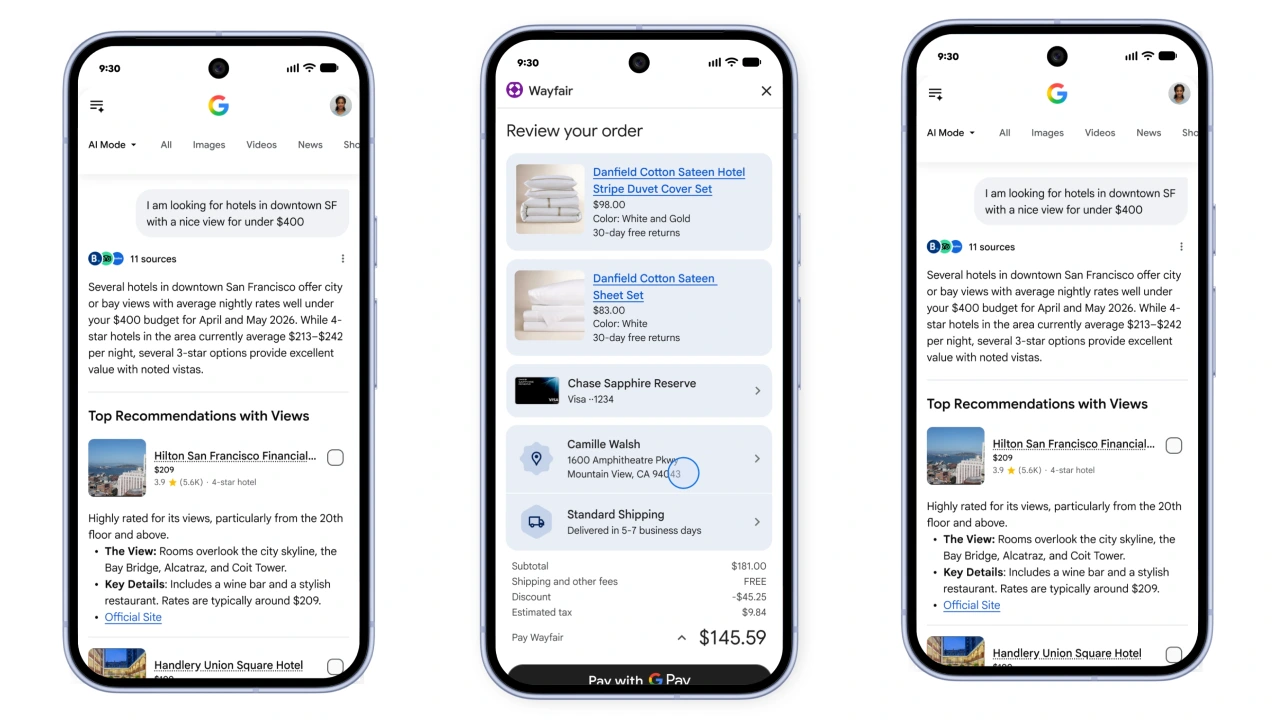
That arrangement is now changing in ways that go far deeper than a redesign or a new ad format. At Google I/O 2026, Google unveiled a new generation of AI-powered advertising experiences built specifically for conversational search — formats that behave less like traditional advertisements and more like intelligent, personalized recommendations woven directly into the answers users are already reading.
The company is calling it a shift from “Search Engine” to “Solution Engine.” That framing is deliberate marketing, but it points to something real. Google is no longer simply placing ads beside search results. It is integrating commerce into AI-generated conversations, embedding sponsored products inside recommendation lists, and building AI agents directly into ad units that can hold real dialogue with prospective customers.
This is not incremental. It is a structural transformation in how search advertising works — and what it’s designed to accomplish.
Understanding what Google announced, why it announced it now, and what it means for advertisers, consumers, and the broader web requires looking beyond the feature list. Because underneath the new ad formats is a much larger strategic reality: Google is rebuilding its advertising model around AI before conversational search has a chance to disrupt it completely.
Key Highlights
- Google unveiled new Gemini-powered advertising formats at Google I/O 2026 designed for AI Mode and conversational Search
- New formats include Conversational Discovery Ads, Highlighted Answers, AI-Powered Shopping Ads, and Business Agent for Leads
- Google says 75% of users report making faster and more confident decisions using AI Mode
- Independent AI Explainers will appear alongside sponsored content to improve transparency
- Direct Offers now include AI-generated bundles, local promotions, dynamic coupons, and native checkout through Universal Commerce Protocol (UCP)
- Travel integrations with Booking.com and Expedia are coming directly inside AI-powered planning experiences
- Brands including Chewy, Gap, and L’Oréal are participating in Direct Offers pilots
- All AI-powered ad experiences will continue carrying “Sponsored” labels
- Advertisers can manage these formats through AI Max and Performance Max
The Core Shift: From Interruption to Integration
The simplest way to understand what Google is doing is this: the company no longer wants ads to feel like ads.
⇒ Also Read: The Heartland’s Digital Renaissance: Inside Google’s $15 Billion Missouri Commitment
That sounds like standard Silicon Valley positioning at first glance, but this change is more structural than cosmetic. Traditional search advertising interrupts the user journey. A person asks a question, receives organic results, and sees advertisements competing for attention beside them.
Gemini-powered advertising attempts to remove that separation entirely.
Instead of existing beside the answer, sponsored products now appear inside AI-generated recommendation flows. Rather than forcing users to leave the conversation to research products independently, Google wants the AI itself to become the shopping advisor.
The result is a very different psychological experience. Users may no longer feel like they are “clicking an ad.” Instead, they are receiving recommendations from an AI assistant that happens to include commercial placements.
That distinction matters enormously because the future of advertising may depend less on visibility and more on trust.
Why Google Had to Move This Fast
Google’s urgency becomes easier to understand when you look at what AI search threatens to dismantle.
Traditional search advertising relies heavily on:
- Keyword-driven discovery
- Blue-link navigation
- External website clicks
- Search result page visibility
Conversational AI changes all four behaviors simultaneously.
Users increasingly expect direct answers rather than lists of websites. AI assistants summarize information instead of sending traffic outward. Product recommendations happen inside conversations instead of across multiple tabs.
⇒ Also Read: Google I/O 2026: Android XR and Gemini-Powered Smart Glasses Redefine Ambient Computing
If Google failed to adapt its advertising model to this behavioral shift, conversational AI could gradually weaken the economic engine that built the company.
That is why the announcements at I/O 2026 matter so much. Google is not simply launching new ad formats. It is redesigning its monetization system for a post-keyword future.
Conversational Discovery Ads: Advertising Based on Intent, Not Keywords
The most ambitious format announced at I/O 2026 is Conversational Discovery Ads.
Traditional search advertising worked best when user intent was transactional and obvious:
- “Buy running shoes size 10”
- “Best laptop under $1200”
- “Cheap flights to Chicago”
But conversational AI has changed how people search.
Instead of typing rigid keywords, users increasingly describe situations, emotions, and goals:
“I want my apartment to feel calmer and less stressful.”
“I need a skincare routine that works for sensitive skin without taking too much time.”
“I’m looking for a backpack that feels professional enough for work but still good for travel.”
These are nuanced, human-style queries that traditional keyword systems struggle to interpret.
Gemini changes that by understanding contextual intent rather than isolated keywords. Conversational Discovery Ads dynamically generate sponsored recommendations around the emotional or situational meaning behind the search.
This could significantly improve ad relevance. But it also changes the relationship between advertisers and Google. Brands will increasingly depend on Gemini’s interpretation of their products — not just their own messaging.
Real-World Example: How This Changes Shopping Behavior
Imagine a user planning a hiking trip to Colorado.
Instead of searching:
“Best waterproof hiking boots men”
they ask:
“I need hiking boots for unpredictable mountain weather that won’t feel heavy during long hikes.”
Gemini could respond with:
- AI-generated recommendations
- sponsored products
- fit explanations
- comfort comparisons
- weather suitability analysis
- price breakdowns
All inside a single conversational experience.
The user may never visit a traditional search results page at all.
That is the future Google is building toward.
Highlighted Answers: Sponsored Products Inside AI Recommendations
One of Google’s biggest monetization challenges is simple: if AI answers replace traditional search results, where do advertisements go?
Highlighted Answers are Google’s solution.
When Gemini generates recommendation lists — whether for software, appliances, financial tools, or travel services — sponsored products can now appear directly inside those AI-generated summaries.
Importantly, Google says these placements will include “Independent AI Explainers.”
These explainers are designed to feel less like marketing copy and more like objective analysis:
- why the product fits the user’s needs
- how it compares with alternatives
- what strengths or tradeoffs matter most
This approach attempts to solve a major modern commerce problem: consumer distrust.
Many users no longer trust traditional ads, affiliate-heavy review sites, or generic SEO comparison articles. Google wants Gemini to become a trusted recommendation layer sitting between users and commercial decisions.
⇒ Also Read: How Apple Intelligence Is Redefining Accessibility — And Why It Matters More Than Any AI Chatbot
Whether consumers ultimately perceive these explainers as genuinely independent or subtly commercialized AI summaries remains an open question.
AI-Powered Shopping Ads and the Fight Against Decision Fatigue
Modern online shopping is exhausting.
Buying a laptop, refrigerator, camera, or television often means:
- reading dozens of reviews
- opening countless tabs
- comparing contradictory opinions
- navigating affiliate-heavy content
- sorting through AI-generated product descriptions
Google’s AI-powered Shopping Ads aim to reduce that friction.
Instead of showing static product listings, Gemini generates contextual buying guidance tailored to each user’s specific needs.
For example, someone searching for:
“Best laptop for video editing and battery life while traveling”
could receive:
- performance analysis
- battery comparisons
- travel suitability insights
- sponsored recommendations
- AI-generated pros and cons
This format is potentially valuable because it solves a real user pain point: decision paralysis.
In categories where users lack confidence, AI-assisted recommendations may genuinely improve the shopping experience while also improving conversion rates for advertisers.
Business Agent for Leads: The Death of the Static Contact Form
One of the most practical announcements from Google I/O 2026 was Business Agent for Leads.
Traditional lead generation has enormous friction:
- users submit forms
- businesses respond hours later
- intent cools down
- conversion rates drop
Business Agent replaces that process with AI-powered conversation.
Instead of waiting for a callback, users can immediately ask questions inside the ad unit itself:
- pricing
- availability
- service areas
- financing options
- tuition costs
- delivery timelines
Google demonstrated education-focused examples, but the implications extend much further.
Real estate, healthcare, automotive sales, legal services, and financial products are all likely candidates for AI-led conversational lead generation.
The larger trend here is important:
AI is becoming the first interaction layer between businesses and customers.
Direct Offers and Native Checkout: Google Wants to Own the Entire Purchase Journey
Google’s Direct Offers expansion may ultimately become one of the most commercially important announcements from I/O 2026.
The company is introducing:
- AI-generated bundles
- dynamic discounts
- personalized promotions
- local offers
- native checkout inside Search
Native checkout through Universal Commerce Protocol (UCP) removes one of the biggest sources of e-commerce abandonment: external landing pages.
Users can now move from:
- research
- comparison
- recommendation
- purchase
without leaving Google’s interface.
This is a major strategic shift.
Historically, Google monetized attention through clicks. Increasingly, it wants to monetize transactions directly.
What This Means for Small Businesses
Much of the conversation around AI-powered advertising focuses on enterprise brands, but small businesses will feel these changes too.
For smaller advertisers, Gemini-powered advertising creates both opportunity and pressure.
On one hand:
- AI-generated ad optimization lowers creative barriers
- better targeting improves local visibility
- Business Agents reduce staffing needs
- smaller brands can compete more intelligently
On the other hand:
- poor website structure becomes a bigger disadvantage
- thin product descriptions hurt AI interpretation
- structured data becomes critical
- technical SEO matters more, not less
Businesses that invest early in clean product data, strong informational content, and well-organized websites are likely to benefit most from Gemini’s recommendation systems.
The Risk of AI Becoming the Internet’s Gatekeeper
There is also a deeper concern underneath all of these announcements.
As AI-generated answers become the dominant interface for information discovery, Google gains enormous influence over:
- which products get surfaced
- which brands get visibility
- how products are framed
- which websites receive traffic
- what information users trust
This creates a concentration-of-power problem that regulators, publishers, and advertisers are increasingly worried about.
If users stop visiting independent websites because Gemini summarizes everything directly, the open web economy could weaken substantially over time.
The paradox is difficult to ignore:
Google’s AI systems depend on the broader web ecosystem for training data and informational context, while simultaneously reducing the traffic that financially sustains many publishers.
That tension will become one of the defining internet debates of the AI era.
Expert Analysis: Google Is Reinventing Advertising to Protect Its Core Business
At a strategic level, Google’s AI advertising push is both defensive and transformative.
The company understands that conversational AI threatens the behavioral foundations of traditional search advertising:
- keyword queries
- blue links
- external browsing
- click-based monetization
Rather than resisting that change, Google is attempting to absorb it.
The strategy is clear:
- make Gemini the shopping advisor
- keep transactions inside Search
- turn AI conversations into monetizable commerce flows
- embed advertising naturally into AI assistance
If successful, Google may preserve its advertising dominance even as search behavior changes fundamentally.
But the success of this strategy depends on trust.
If users feel manipulated by AI-mediated recommendations, adoption could slow. If regulators decide conversational advertising crosses transparency boundaries, new disclosure rules may emerge quickly.
The technology is advancing faster than the policy frameworks governing it.
Pros and Cons
Pros
- Conversational advertising aligns more naturally with real user intent
- AI explainers can improve product understanding and purchase confidence
- Business Agent reduces lead-response delays dramatically
- Native checkout removes friction from online purchasing
- AI-powered recommendations may reduce decision fatigue
- Small businesses gain access to advanced AI optimization tools
- Travel and commerce experiences become more seamless
Cons
- The line between recommendations and advertising becomes psychologically blurrier
- Publishers face additional traffic decline as users remain inside Google
- AI-generated explainers may misrepresent products unintentionally
- Businesses become increasingly dependent on Google’s ecosystem
- Privacy concerns around conversational intent data will intensify
- Regulatory frameworks for AI-native advertising remain unclear
Future Impact: Entering the Post-Click Era
The phrase “post-click internet” has existed for years, but Google’s I/O 2026 announcements finally give it practical meaning.
When:
- AI agents answer questions
- recommendations happen inside conversations
- checkout happens inside Search
- product evaluation happens through Gemini
the traditional click to an external website becomes optional.
That is not a cosmetic change to advertising. It is a structural redesign of digital commerce itself.
Companies with strong structured data, rich product catalogs, and authoritative informational content will likely gain advantages in this environment.
Businesses still relying on shallow SEO tactics, low-quality landing pages, or outdated keyword strategies may struggle to remain visible.
The future of search advertising increasingly belongs to brands that can teach AI systems how to represent them effectively.
Frequently Asked Questions
What are Google’s new Gemini-powered advertising formats?
Google introduced several AI-native advertising formats including Conversational Discovery Ads, Highlighted Answers, AI-powered Shopping Ads, and Business Agent for Leads. These formats are designed specifically for conversational Search and AI Mode experiences.
Will AI-powered ads still be labeled as sponsored?
Yes. Google confirmed that all AI-powered advertising experiences will continue displaying “Sponsored” labels, although the integration into conversational responses raises new transparency questions.
What is Business Agent for Leads?
Business Agent for Leads is an AI-powered conversational interface embedded inside advertisements that allows users to ask real-time questions instead of filling out static contact forms.
What is Universal Commerce Protocol (UCP)?
UCP enables native checkout inside Google Search experiences, allowing users to complete purchases without leaving Google’s ecosystem.
How are Conversational Discovery Ads different from traditional ads?
Traditional search ads rely on keyword targeting and static copy. Conversational Discovery Ads use Gemini to understand contextual user intent and dynamically generate recommendations tailored to natural language queries.
How should businesses prepare for AI-powered search advertising?
Businesses should prioritize structured data optimization, detailed product information, strong website organization, and high-quality informational content to help Gemini accurately interpret and represent their products.
Conclusion
What Google announced at I/O 2026 is the most significant transformation in search advertising since AdWords launched more than two decades ago.
The old model:
- keywords
- static ads
- blue links
- external landing pages
is gradually being replaced by AI-mediated commercial assistance woven directly into conversational experiences.
The opportunities are enormous:
- better personalization
- higher purchase confidence
- reduced friction
- smarter product matching
But the concerns are equally serious:
- transparency
- publisher sustainability
- AI influence over consumer decisions
- platform dependency
- regulatory uncertainty
The future of advertising will likely depend on whether AI systems can remain genuinely helpful while still operating as commercial platforms.
Google believes it can balance both.
The rest of the industry — and ultimately consumers themselves — will decide whether that balance actually holds.
What Do You Think?
Google’s Gemini-powered advertising system raises a fundamental question:
When AI recommendations become both genuinely useful and commercially sponsored, is a “Sponsored” label enough?
Would you trust AI-generated product explainers more than traditional advertisements? Or do these new formats blur the line between guidance and marketing too much?
Share your thoughts in the comments below.
If this breakdown helped you understand how AI is reshaping search advertising and digital commerce, share it with someone following the future of Google, AI Search, and online advertising.