
I’ve spent the better part of two decades staring at smartphone screens, and honestly, I think many of us are hitting a kind of app fatigue.
Our phones no longer feel “smart” in the way the industry originally promised. Instead, they often resemble cluttered digital filing cabinets filled with dozens — sometimes hundreds — of disconnected apps constantly competing for our attention.
After watching Google’s Android Show presentation this week, though, I came away thinking something important is changing.
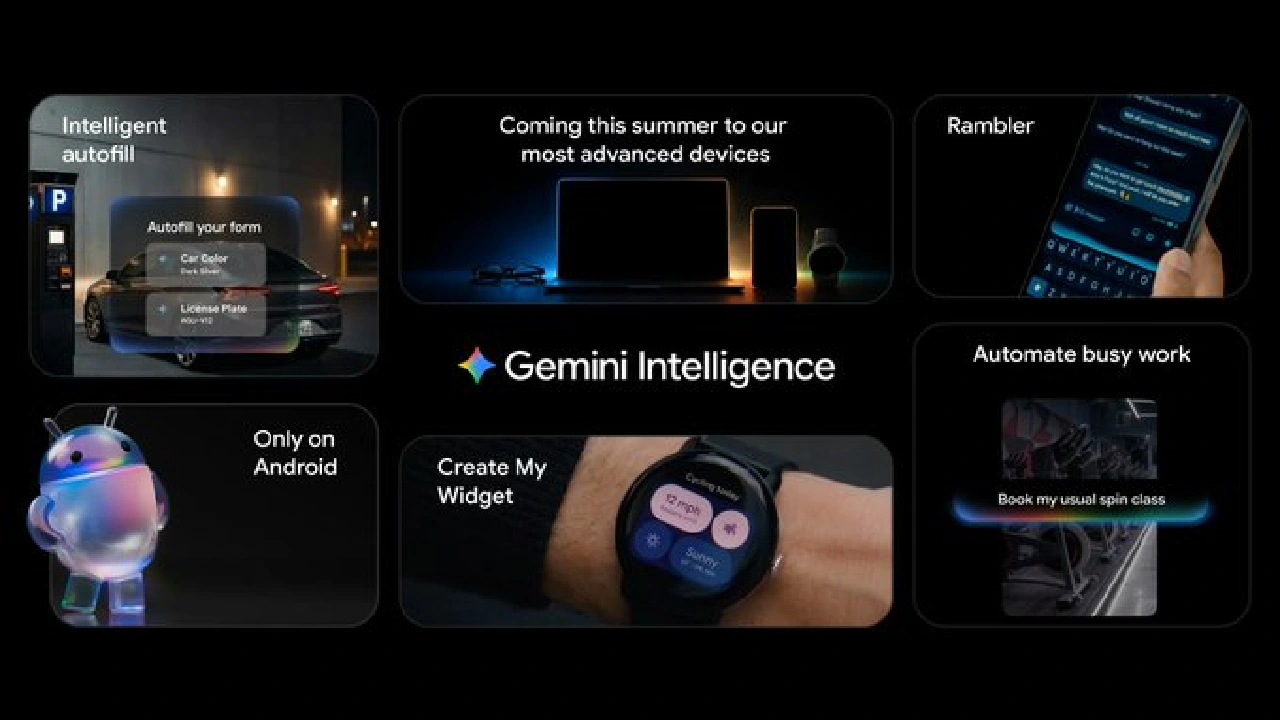
Google isn’t simply adding more AI features to Android. It appears to be restructuring the entire operating system around Gemini Intelligence as a persistent, context-aware assistant that operates across apps instead of inside them.
That distinction matters.
The End of “App Bouncing”
We’ve all experienced the same frustrating workflow.
You’re filling out a rental application or checking into a flight on your phone. Suddenly you need your passport number, insurance document, or saved ID.
So you:
- leave the browser,
- open Google Drive,
- search for the document,
- copy the information,
- return to the original app,
- and paste everything manually.
It’s tedious digital busywork.
During Google’s demo, Gemini Intelligence handled that entire process automatically by pulling information directly from a secure Drive folder and filling the form contextually.
That’s a much bigger shift than it sounds.
As Ben Greenwood, an Android product manager, reportedly explained during the presentation, Google’s goal is not to create a flashy “Times Square of AI” filled with distracting gimmicks.
Instead, the company wants Gemini to function more like a quiet assistant that understands user intent and reduces friction across the operating system itself.
And honestly, that’s the first AI pitch in a while that feels genuinely useful to me.
Why “Rambler” Might Become the Most Important AI Feature on Android
While most of the attention will inevitably go toward chatbots and AI assistants, the feature that actually impressed me most was something much smaller — and much smarter.
Google calls it “Rambler.”
If you regularly use voice-to-text, you already know how messy natural speech can be.
“Hey, grab milk, eggs — actually no, we still have eggs — and maybe coffee too.”
Most voice assistants either transcribe everything awkwardly or require constant corrections afterward.
Rambler reportedly understands conversational intent more intelligently.
It filters out filler words, corrections, pauses, and self-edits to generate a much cleaner final message automatically. Google also demonstrated multilingual switching mid-sentence for bilingual users — something that could be surprisingly valuable in real-world households.
What I like most is that Rambler doesn’t feel like “performative AI.”
It’s not asking users to dramatically change their behavior or speak in prompts. It simply improves an existing interaction quietly in the background.
That’s the kind of AI feature people actually end up using every day.
The Summer Hardware Battle Is About to Get Interesting
For US consumers, the timing of Gemini Intelligence could be extremely important.
Google confirmed that these features are expected to arrive first on select Samsung Galaxy and Google Pixel devices later this summer.
That sets up an interesting competitive moment for the smartphone market.
The upcoming Pixel 10 lineup and Samsung’s next-generation foldables — widely expected to include the Galaxy Z Fold 7 and Z Flip 7 — will likely become the flagship platforms for Google’s AI strategy.
Meanwhile, Apple is still refining Apple Intelligence across the iPhone ecosystem.
The major difference right now is integration depth.
Because Google already controls Gmail, Google Maps, Drive, Android, Chrome, Calendar, and Search, Gemini potentially has access to a far richer contextual ecosystem than Siri currently does.
That could give Android a meaningful AI advantage for the first time in years.
Is This the Beginning of an “App-Less” Future?
For the past year, analysts including Ming-Chi Kuo have increasingly discussed the possibility that AI assistants may eventually replace many traditional apps entirely.
“Get me a ride home.”
Google doesn’t appear to be eliminating apps outright — at least not yet.
But the company is clearly trying to hide the underlying complexity.
Whether you’re using Android Auto, smart glasses, or your phone itself, the goal appears to be consistent task completion rather than app navigation.
Take a photo of a concert flyer, and Gemini could theoretically:
- identify the event,
- suggest tickets,
- add it to your calendar,
- map directions,
- and notify friends
without forcing you to manually jump between multiple services.
That’s a fundamentally different model of computing.
My Take: The Real Question Is Trust
The biggest question isn’t whether the technology works.
The bigger question is whether users are comfortable allowing AI systems this level of access and autonomy.
Letting an assistant scan personal documents, interpret messages, manage purchases, and coordinate schedules requires a significant amount of trust — especially when the ecosystem is controlled by a company as data-centric as Google.
But after watching this week’s demonstrations, one thing became clear to me:
Google is betting that consumer frustration with app overload is becoming stronger than privacy hesitation.
And honestly, they may be right.
If Gemini can genuinely eliminate even 15 or 20 minutes of repetitive phone management every week, most users will probably embrace it faster than critics expect.
Quick Reader FAQ
Will Gemini Intelligence work on older Android phones?
Probably not at first.
Google appears to be targeting newer premium devices initially, likely starting with the Pixel 10 lineup and Samsung Galaxy S26 series.
Features like Rambler and advanced on-device form processing require newer NPUs (Neural Processing Units) capable of handling AI workloads locally.
Is Gemini Intelligence the same as Apple Intelligence?
No.
While both platforms aim to integrate AI deeply into smartphones, Gemini Intelligence appears more focused on task execution and cross-app functionality using Google services like Gmail, Maps, and Drive.
Apple Intelligence currently emphasizes writing tools, summarization, and photo-related AI features more heavily.
Will Gemini Intelligence require a subscription?
Google has not confirmed whether these operating-system-level AI features will require a paid Gemini subscription.
However, some advanced chatbot capabilities and cloud-based AI services could eventually become part of a premium tier.